
The Hidden Gaps Between
Strategy & Execution
Your strategy can be sound. Execution can still stall.

Practical Leadership Session
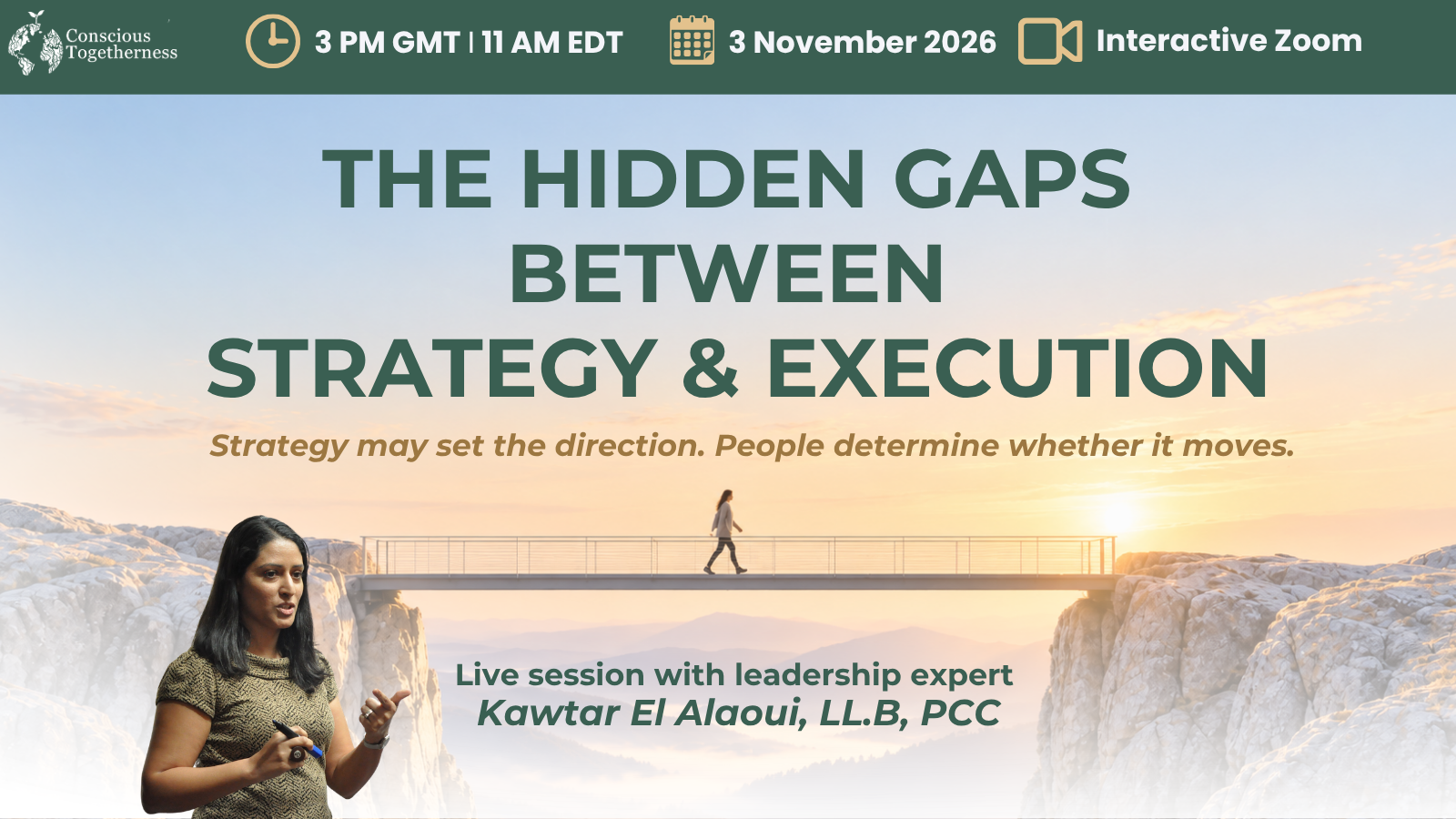
Strategy may set the direction but people determine how it moves.
In times of complexity and change, collaboration becomes harder just when the organisation needs it most.
The direction has been agreed, the plan makes sense, meetings are happening, leaders are communicating and teams leave meetings confident.
And yet something is not moving. People are slow to engage with change, the same tensions keep resurfacing and execution stalls, slows down or turns in circles. Misunderstandings consume time and energy.
When this happens, the leadership instinct is often to revisit the strategy, add another process, communicate more information or push harder for action.
But what if the problem is, in fact, being addressed at the wrong level?
Often, the missing pieces sit in:
- What people understand.
- What they trust.
- What they fear losing.
- What they are not saying.
- How they respond when pressure increases.
- And the resulting actions that either move change forward or quietly stall it.
You Will Explore:
 Why organisations often address execution problems at the wrong level. Learn to recognise when a strategic, structural or process problem may actually have a human or relational layer underneath it.
What happens to people during change, and what helps them move forward. Explore why uncertainty and pressure can create resistance, withdrawal, tension or stalled action, and what helps people regain clarity, trust and momentum.
How communication becomes a strategic lever for execution.
Real Business Examples
Kawtar will invite you to bring one real challenge from your team or organisation and look at it through a practical diagnostic lens.
She will share real examples of gaps leaders have noticed in her work with them - and how they bridged the gap with her guidance.
You will leave with a different way of looking at the gap between what your organisation wants to achieve and what is happening in practice.
This conversation will be particularly relevant if:
- Strategy has been agreed, but execution is slower than expected.
- People are not fully engaging with change.
- Meetings happen, but real alignment does not follow.
- Tension or misunderstanding is slowing collaboration.
- Leaders are communicating, but the message is not creating movement.
About Kawtar
Kawtar El Alaoui, LL.B, PCC, is the Founder and CEO of Conscious Togetherness®.
For more than 20 years, her work has crossed law, mediation, executive coaching, leadership development, facilitation, diversity and inclusion, and conflict transformation. She has been an ICF-accredited coach for more than a decade, and she teaches coaching, mentors and assesses coaches a mediation trainer.
Her work focuses on questions many organisations eventually face: What needs to change, where and how for strategy, culture and transformation to move forward effectively?
At the heart of her work is a systemic model of cultural transformation that looks at change across four interconnected levels: Personal, Relational, Cultural and Systemic. This helps leaders recognise when a challenge that appears to be about strategy, process or performance may also be shaped by trust, communication, behavioural norms, organisational structures or the way people are experiencing change.
Kawtar is the author of Unfolding Peace: 9 Leadership Principles to Create Cultures of Wellbeing, Belonging & Peace. Drawing on research, case studies and lived practice, the book explores how the inner conditions of leadership influence the way people relate, make decisions and create impact around them.
Her work has supported leaders and organisations internationally, alongside executives, HR and People leaders across different cultural and organisational contexts.
